
Can a browser extension really replace two or three separate DeFi tools on your desktop?
That’s the sharp question Rabby forces on advanced DeFi users: can a single, non-custodial multi-chain wallet reduce operational friction while materially improving safety for active traders, liquidity providers, and custodial teams? The short answer is “it depends,” and the value lies in the wallet’s mechanisms — not the marketing. This piece parses how Rabby approaches three recurring pain points for U.S.-based DeFi power users: blind signing, manual network juggling, and portfolio visibility — and where the trade-offs and limitations still matter.
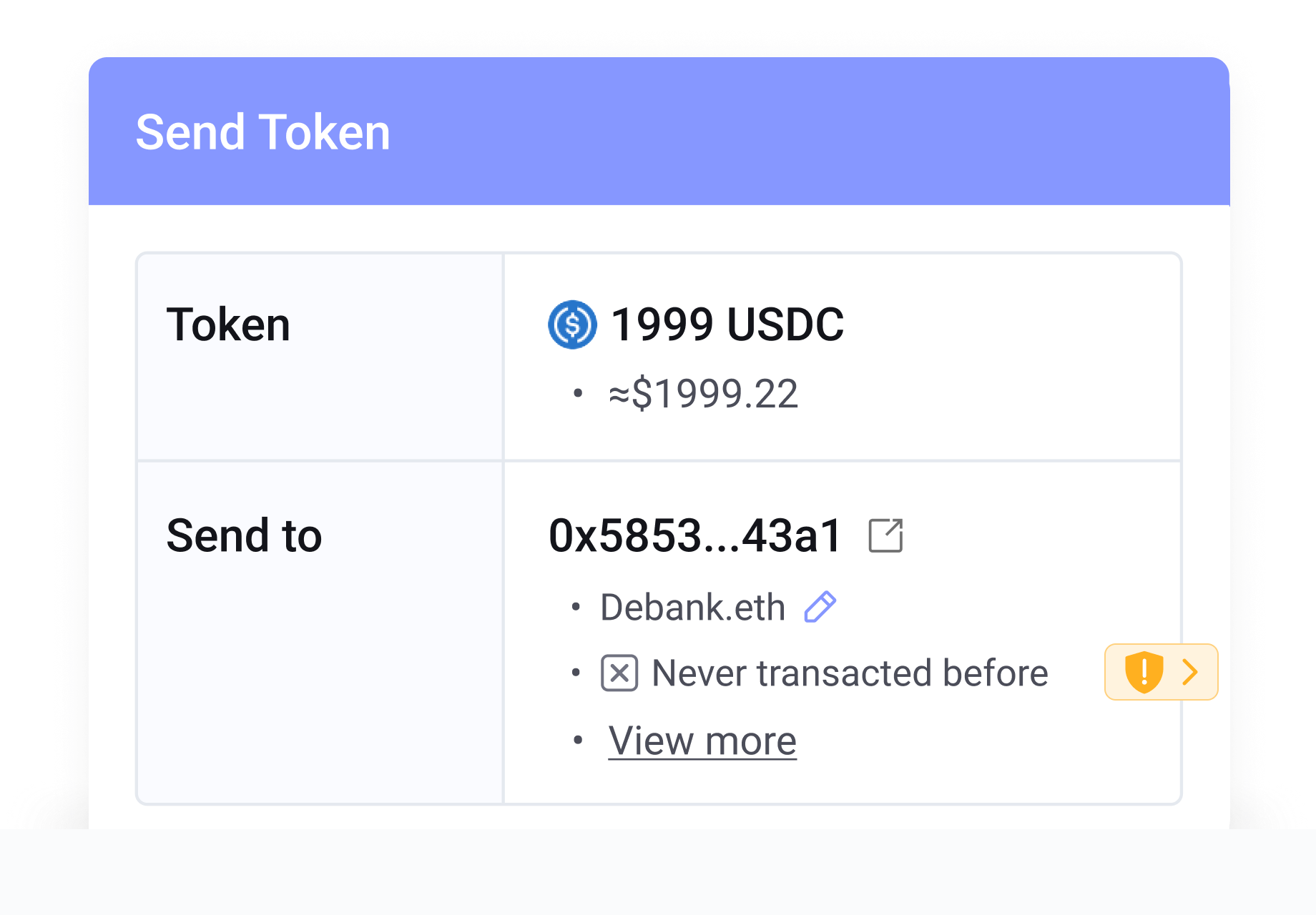
Start with the mechanism most obvious to experts but often misunderstood by newcomers: transaction simulation. Unlike a simple signature pop-up, Rabby runs a local simulation of the on-chain effect before you sign. That means you don’t just see the function name or a raw calldata string; you see predicted token balance changes, gas costs, and a simple risk filter highlighting red flags. Mechanism-first, this reduces a specific class of attacks (malicious or buggy contracts that trick users into unknowingly transferring assets) by converting opaque calldata into human-interpretable outcomes.
How Rabby’s features map to real DeFi workflows
For power users, a wallet is a workflow hub. Rabby is accessible as a Chromium extension (Chrome, Brave, Edge), mobile apps (iOS/Android), and desktop clients (Windows/macOS). That breadth matters when you run sophisticated flows across many dApps. Three mechanisms change daily operations.
1) Transaction simulation and pre-transaction risk scanning: these are complementary. Simulation predicts asset movement; the security engine cross-references contract histories and common risk patterns (e.g., prior hacks, suspicious approval requests). Together they replace blind signing with an interpretable check. This is where Rabby differentiates from many mainstream alternatives.
2) Automatic network switching eliminates one of the most annoying sources of user error: interacting with a contract on the wrong chain. For a U.S.-based trader switching between Ethereum L1, Arbitrum, and Polygon, automatic switching reduces time loss and prevents failed transactions that can cost gas and time.
3) Aggregated portfolio tracking: instead of toggling multiple explorers and DEX dashboards, Rabby consolidates token balances, NFTs, and DeFi positions (liquidity pools, lending, and staking positions) across connected chains into a single dashboard. This aggregation is especially useful for risk monitoring and quick rebalancing.
Where the wallet helps and where it still won’t replace other tools
Rabby is strong on user-facing security mechanics and integrations, but no wallet is a silver bullet. Important boundary conditions for advanced users:
– No native fiat on-ramp. If you need to buy USD-to-crypto inside the wallet, Rabby currently requires external services. That matters for onramps into regulated U.S. rails and tax tracking workflows that start with fiat purchases.
– No built-in staking module. Rabby can surface staking positions in its portfolio view, but native delegation, validator management, or in-wallet staking UI is absent — so validators or staking-heavy users still rely on dedicated staking interfaces or exchanges.
– Past incident history matters. In 2022 a Rabby Swap smart contract was exploited (~$190k). The team froze the contract and compensated users, then strengthened audits. That sequence shows both the risk and a responsible remediation path; it’s evidence that audit + response matters but cannot erase residual risk perceptions among institutions.
– Integration vs. custody trade-off. Rabby integrates with institutional tools (Gnosis Safe, Fireblocks, Amber), which enables multi-sig and custodian workflows. But integration is not the same as custody: Rabby remains non-custodial by design, so teams wanting fully delegated custody will still use enterprise-grade custodians.
Practical heuristics for deciding whether to install the Rabby Chrome extension
Here are four decision-useful heuristics for U.S. DeFi power users evaluating the Rabby extension.
1) If you frequently interact with many EVM dApps and chains (Ethereum, Arbitrum, Optimism, BNB Chain, Polygon, Avalanche), Rabby’s automatic network switching and multi-chain support (90+ EVM chains) reduce cognitive overhead and error. Install if multi-chain workflow is core to your trading or market-making.
2) If you sign complex permissioned transactions or use smart contracts often, the transaction simulation plus pre-transaction risk scanning materially lowers the probability of a blind-signing loss. That’s a strong reason to use Rabby as the primary signing agent, even if you keep another wallet for occasional use.
3) If you need fiat rails or in-wallet staking, Rabby is incomplete. Use Rabby for secure on-chain interactions and a separate fiat provider or staking platform for those activities.
4) For institutional setups or high-value accounts, combine Rabby with a hardware wallet (Ledger, Trezor, Keystone supported) or multi-sig provider. Rabby’s hardware compatibility enables the best of both worlds: strong UX and hardware-level private key security.
Non-obvious trade-offs and a clearer mental model
Here’s a mental model that clarifies what Rabby is and isn’t: think of Rabby as a safety-enhanced frontend and router for DeFi activity, not as an all-in-one financial product. The wallet shifts risk from “human misinterpretation of calldata” to “trust in the wallet’s simulation and scanning heuristics.” That is, you still must trust that Rabby’s simulation correctly models on-chain effects and that its security signals are timely. The open-source MIT license helps because it enables third-party audits and community scrutiny, but open source does not automatically equal flawless security. Audits find issues; ongoing monitoring and responsible disclosure matter.
Another trade-off: combining convenience and security can create central points of failure. Automatic network switching is convenient, but if it misroutes you to an attacker-controlled RPC endpoint (a low-probability but plausible attack vector), the convenience becomes a risk. Practically, that risk is mitigated by conservative default RPCs, hardware wallet signing, and user attention to unusual prompts.
Near-term signals to watch
Because there is no weekly project news in the current window, evaluate Rabby on structural features and the team’s historical responsiveness. Monitor three signals:
– Frequency and depth of security audits and post-audit mitigations (shows commitment to hardening the simulation and risk engine).
– Native feature expansion toward fiat on-ramps or staking (if Rabby adds these, it would shift it toward an all-in-one product and raise regulatory questions in the U.S.).
– Integration updates with enterprise custodians and multi-sig tools (indicates whether Rabby is increasing adoption among institutional users who require compliance workflows).
For readers who want to try the extension and read implementation notes directly from a maintained project page, this link points to Rabby resources and installation guidance: rabby wallet.
FAQ
Q: Does Rabby remove the need for a hardware wallet?
No. Rabby supports hardware wallets (Ledger, Trezor, Keystone, and others), and for high-value accounts the recommended setup is Rabby as the UX layer with a hardware device for signing. That preserves Rabby’s conveniences while keeping private keys offline.
Q: Can Rabby prevent all smart contract exploits?
No. Rabby’s simulation and risk engine reduce specific classes of user-facing risks (blind signing, known malicious contracts, suspicious approvals), but it cannot guarantee immunity to zero-day contract vulnerabilities or sophisticated social-engineering attacks. Always use layered defenses: hardware signing, approval revocation, and off-chain operational security.
Q: Is Rabby suitable for institutional custody?
Rabby integrates with institutional tools like Gnosis Safe and Fireblocks to support multi-sig and custodial workflows. That makes it useful as part of institutional stacks, but institutions should treat Rabby as an integration layer and pair it with their chosen custodial or multi-sig security controls.
Q: What should U.S. users watch for regarding regulation or compliance?
Rabby is non-custodial and open-source; that reduces certain regulatory touchpoints compared with centralized custody. However, features such as native fiat on-ramps (currently absent) or expanded KYC integrations could shift regulatory exposure. U.S. users and teams should separate on-chain operational security from regulatory choices like where to buy fiat on-ramps or how to report taxable events.