
Can a wallet tell you what you’re about to sign before you sign it? A practical look at Rabby for DeFi power users
What if the single most dangerous moment in DeFi—the instant you click “Confirm”—could be rendered visible and intelligible instead of opaque? That’s the practical promise Rabby Wallet aims to deliver: not just another browser wallet, but a front-line tool that simulates and annotates transactions so users can see estimated token flows, fees, and known risks before signing. For experienced DeFi users in the US who move capital across chains, use multisigs, or interact with complex smart contracts, that shift from “blind signing” to pre-transaction visibility changes the risk model in a way worth unpacking.
This commentary examines how Rabby’s mechanisms work, where they matter, their limits, and what a sensible power-user should consider when deciding whether to download and install the browser extension, use the mobile or desktop client, or integrate it into an institutional stack.
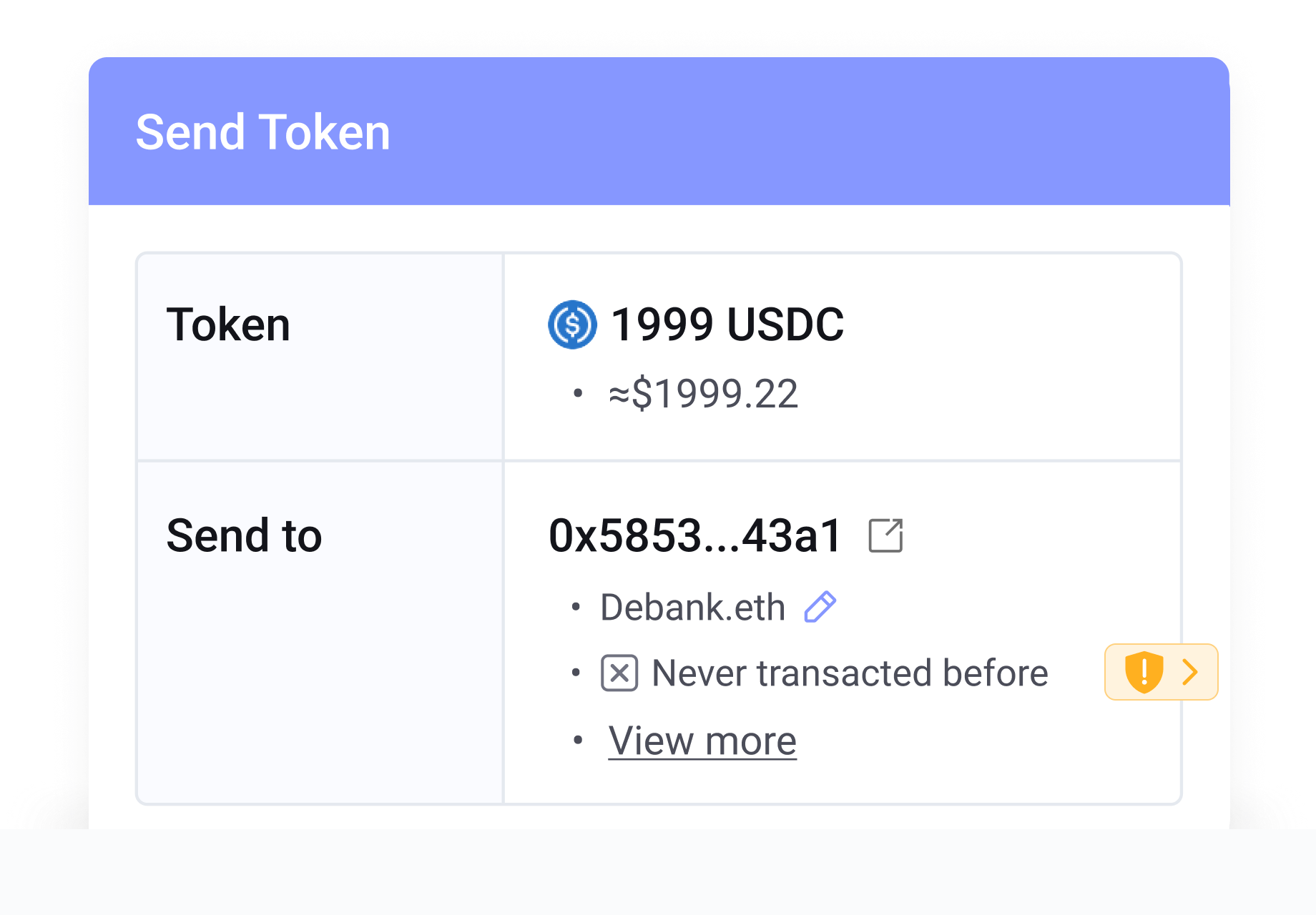
How Rabby changes the signing moment: mechanism first
Rabby’s core differentiator is transaction simulation. Before the wallet hands your private key (or hardware device) a signing request, Rabby runs the transaction through a local simulation engine and presents an itemized view: which tokens leave or arrive, estimated gas and fee breakdown, and whether the destination or contracts have historical risk flags. Mechanistically, that requires replicating the smart-contract calls off-chain (or via a read-only node), decoding events, and mapping those events to human-friendly balance deltas. For a user, the result is concrete: a predicted ETH outflow here, 1,200 USDC inflow there, plus fee estimates—rather than a terse “approve” popup.
That simulation complements two other controls important to power users: built-in revocation of approvals (to prune infinite allowances) and automatic network switching that matches the dApp you visit to the correct EVM chain. Put together, these reduce two common operational errors: signing unintended approvals and sending transactions on the wrong chain.
Install surface: platforms, hardware, and institutional hooks
Rabby is available as a Chromium-based browser extension (Chrome, Brave, Edge), as well as mobile (iOS, Android) and desktop clients (Windows, macOS). From a practical security standpoint, the browser extension is the primary surface DeFi users will first encounter for dApp interactions. Power users should pair it with a hardware wallet—Rabby supports Ledger, Trezor, Keystone, CoolWallet, GridPlus, and BitBox02—so private keys never reside on the browser device.
Institutional and multi-sig support is an explicit design point: Rabby integrates with Gnosis Safe and enterprise custody providers such as Fireblocks, Amber, and Cobo. That integration makes Rabby usable as a policy and UX layer over institutional key management, preserving auditability while enabling pre-transaction checks that are otherwise absent in many enterprise workflows.
Security posture, past incident, and what it implies
Two facts anchor any realistic appraisal. First, Rabby is open source under the MIT license, which invites independent audits and community scrutiny. Second, Rabby’s ecosystem has seen a real loss: in 2022 a smart contract tied to Rabby Swap was exploited for about $190,000; the team froze the contract, compensated victims, and increased audits. That history matters in two ways. It shows the team responds and remediates—useful evidence of operational maturity—but it also underscores that simulation and UX protections live alongside, not instead of, conventional smart-contract security review. A wallet can reduce human error and detect flagged contracts; it cannot retroactively make an insecure contract secure.
In short: Rabby reduces surface risk at the client layer but does not eliminate systemic smart-contract vulnerabilities. Power users should treat Rabby’s alerts as one input among many: code audits, protocol reputation, and on-chain scrutiny remain necessary.
Where Rabby helps most—and where it currently falls short
Rabby’s strengths are scenario-driven. If you regularly: (a) move between multiple EVM chains; (b) interact with complex DeFi protocols and aggregators; (c) accept token approvals frequently; or (d) operate inside a multi-sig or institutional environment, Rabby’s simulation, approval revocation, cross-chain gas top-up, and automatic network switching materially change the operational risk equation. The portfolio dashboard that aggregates tokens, NFTs, and DeFi positions is also a meaningful time-saver for users managing tens or hundreds of on-chain positions.
But there are trade-offs and clear limitations. Rabby has no built-in fiat on-ramp, so US users still need external providers to convert USD to crypto. There is no native in-wallet staking interface—so validators or staking protocols are interacted with indirectly. The simulation engine is powerful, but it can only predict behavior that the simulation environment models; complex oracle-driven or time-dependent contract logic may behave differently on-chain, especially under conditions of network congestion or MEV (miner/relayer) influence. Finally, usability for newcomers remains lower than consumer-grade alternatives, because the interface exposes technical detail by design.
Comparing alternatives: when Rabby is the right tool
Compared to mainstream EVM wallets—MetaMask, Trust Wallet, Coinbase Wallet—Rabby’s distinctive claim is its security-first UX: pre-transaction simulation, revocation tooling, and automatic network switching. If your primary goal is simple custody and fiat on-ramp convenience, one of the mainstream wallets may be more convenient in the US market. If your priority is minimizing accidental approvals, avoiding blind signing, and integrating with hardware and institutional custody, Rabby is a defensible choice. A practical heuristic: use Rabby when the marginal cost of a blocked or reverted high-value transaction is large enough to justify the slightly steeper UX and configuration overhead.
If you want to try it, start with the browser extension and pair it immediately with a hardware wallet. The extension download and install path is the usual browser-extension workflow; the project also maintains mobile and desktop clients for different operational contexts. For a direct starting point, see this guide to the rabby wallet.
Decision-useful framework: three questions before you install
Ask yourself these three focused questions before making Rabby your daily driver:
1) What is the typical dollar value and complexity of the transactions I sign? High-dollar or multi-step DeFi positions benefit more from simulation. Low-value, frequent retail trades may not.
2) Will I pair the wallet with a hardware key or custody provider? The security benefit is strongly conditional on integrating Rabby with a cold key or institutional custody; browser-only key storage reduces the marginal value of simulation.
3) Do I require fiat on-ramps or in-wallet staking? If yes, expect external tooling; Rabby will not replace exchanges or staking dashboards today.
What to watch next: signals that would materially change the assessment
Three near-term developments would alter the calculus. First, a built-in fiat on-ramp or native staking would broaden Rabby’s appeal to mid-tier users and reduce reliance on external services. Second, industry adoption of client-side simulation as a de facto standard—when multiple wallets ship similar features—would lower Rabby’s relative differentiation, forcing new innovation. Third, any future serious security incident would test both Rabby’s response processes and the effectiveness of simulation as a damage-limiting control. Monitor product releases and audit reports; those are the empirical signals that should change behavior rather than marketing claims.
FAQ
How does transaction simulation prevent scams or exploits?
Simulation doesn’t make contracts secure, but it reveals immediate, visible consequences of a transaction (token flows, fees, approvals) before you sign. It can flag historically hacked contracts and suspicious approval requests, which helps catch social-engineered or obfuscated prompts. However, simulation cannot predict every runtime oracle attack or logic exploit—so it is a risk-reduction tool, not a fail-safe.
Is Rabby safe to install as my everyday browser wallet?
“Safe” depends on your threat model. For active DeFi users, Rabby adds meaningful defenses (simulation, approval revocation, hardware wallet support). For custody or institutional use, its integrations with Gnosis Safe and enterprise custodians are valuable. But because the extension interacts with dApps, following best practices—use hardware keys, keep seed phrases offline, and review contract code or audits for high-value transactions—remains essential.
Can Rabby replace my exchange for US-dollar on-ramps?
No. Rabby currently lacks a built-in fiat on-ramp. US users will still rely on regulated exchanges or third-party services to purchase crypto with fiat before depositing to Rabby-managed addresses.
Does Rabby support all EVM chains I might use?
Rabby supports over 90 EVM-compatible chains, including Ethereum, BNB Chain, Arbitrum, Optimism, Polygon, and Avalanche. That breadth is useful for multi-chain strategies, but some niche or experimental chains may not be fully supported or tested.
Conclusion: Rabby is best understood as a pragmatic tightening of the client-side security layer. Its core mechanism—simulating transactions and exposing balance deltas—addresses a specific and recurring failure mode in DeFi: blind signing. For US-based power users who value visibility, hardware integration, and institutional connectivity, Rabby should be on the shortlist. But it is not a panacea: it amplifies good operational hygiene while leaving systemic smart-contract risk and on-ramps to other parts of the stack. Adopt it as part of a layered defense, and watch audit reports and product updates to recalibrate trust over time.